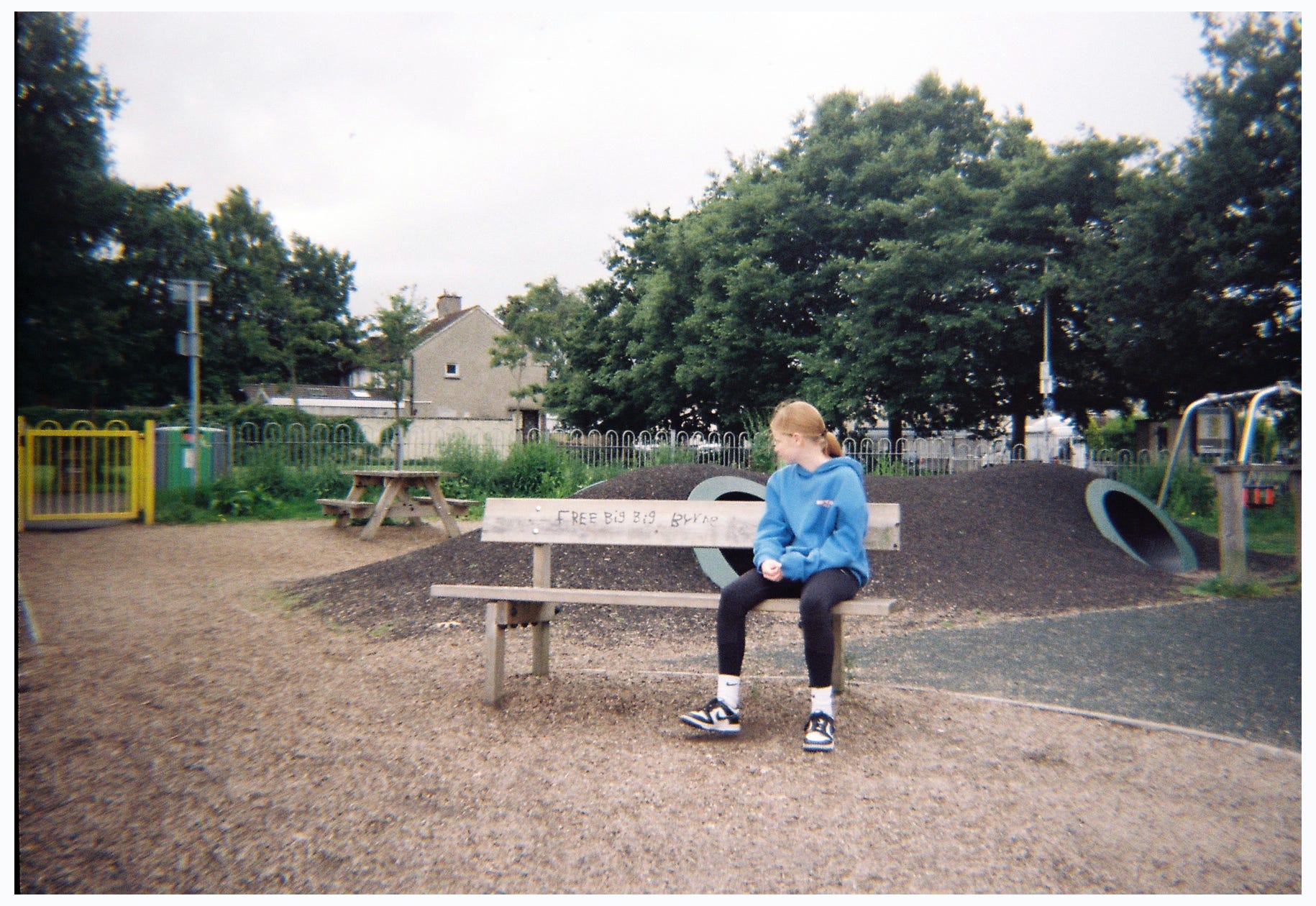
My daughter moves through the house aloofly, often on the make, keeping herself on the periphery. It is strange to see. I flatter myself by questioning: is this why I took so many photographs of her last year? Some sort of pre-emptive foresight that she’d soon be more independent, moving out of the fold.
My sons grow closer and we spend more time as a trio. The pictures take on a different energy. In the youngest I see a quiet watchfulness, which I recognise from having once been the smallest. His older brother is a big character, with emotions that change minute by minute. I wonder if photographs can encapsulate these qualities, embalm them, but also become something universal, relatable, perhaps about loss. The Current Joys song Kids describes this feeling much better than I can in words. I sometimes wonder if my kids, as individuals, feel “seen,” but how would you ask such a question.
Is it vulnerability I’m looking for, or longing, or a combination of both? One of my favourite singer-songwriters, Alex G, often performs facing away from the crowd. Some people complain about this, but I get it: his songs leave him wide open. Maybe turning away from spectators is a small act of self-preservation. I admire artists who are open and vulnerable in this way, risking ridicule and judgement. Photography feels like a risk somehow, especially in the sharing of my day-to-day life. There is no skin of paint for me to withdraw into.
Recently I wrote about a couple of my photographs for a submission. The first is a 35mm film photograph of my sons, taken on a grassy green space at the edge of our suburban neighbourhood. It captures a quiet moment of being together, where closeness and distance exist at the same time.
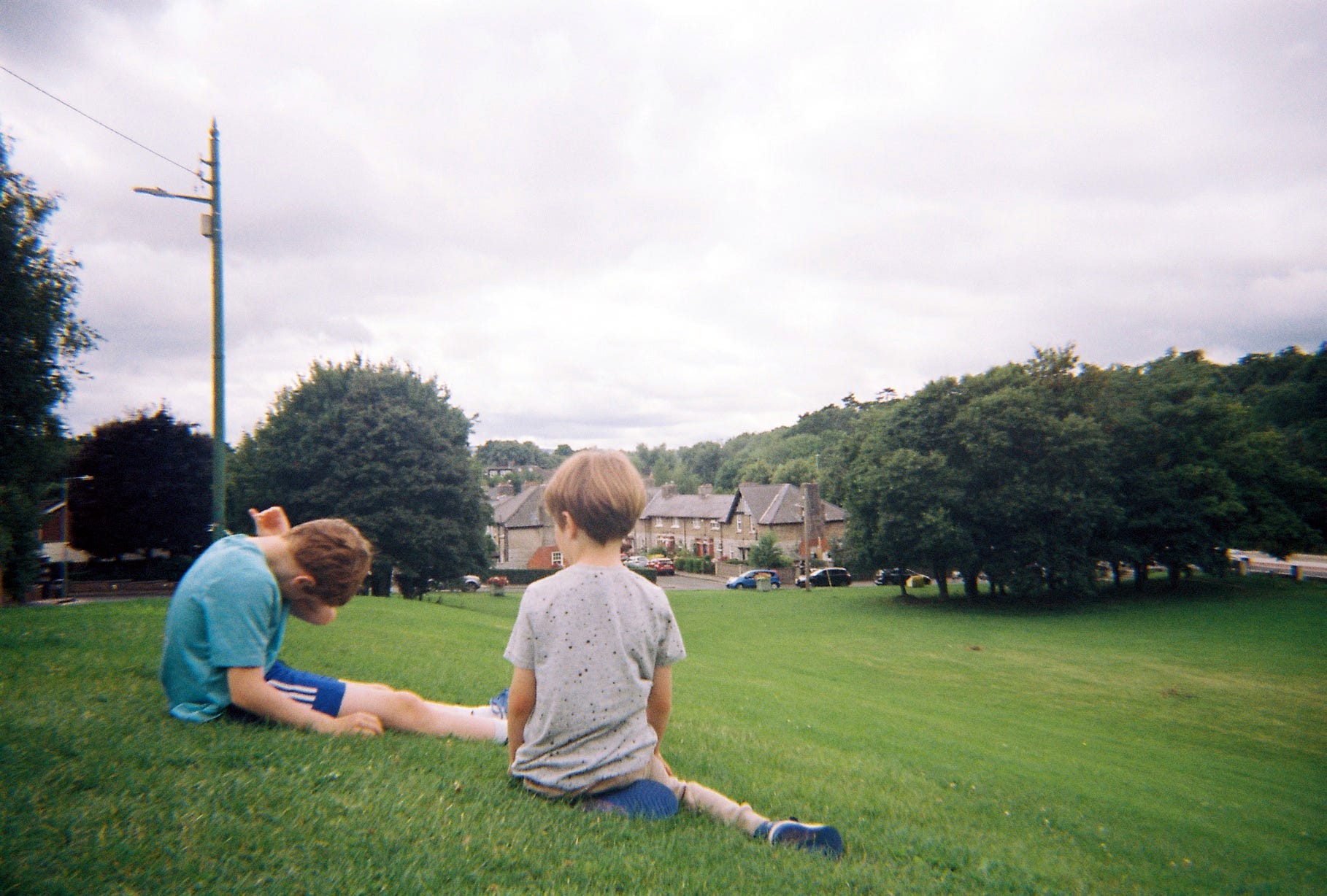
They sit on the grass facing away from me, their bodies turned toward the landscape rather than the camera. One leans forward, absorbed in his own world, while the other sits upright, smaller, more still. Beyond them, rows of houses line the horizon, softened by trees and an overcast sky. The setting feels open, yet clearly bounded, a shared public space shaped by routine, familiarity, and repetition.
As their mother, I’m drawn to these moments of pause rather than action. There is no obvious play or drama here, only the subtle language of posture and proximity. Their closeness suggests intimacy, but the slight separation between them hints at individuality emerging, different rhythms, different ways of occupying the same space. It reflects how childhood is often lived side by side: together but separate.
The softness of the film, the muted colour, and the gentle distance of the framing echo how these moments lodge in my memory, with quiet emphasis. The suburban landscape becomes a backdrop for our family life, a place where companionship, solitude, boredom, and belonging coexist.
Writing about my photography is new; I’m not sure how to write about something that feels like a reflex. The second photograph was taken on a wide stretch of grass where my son lies face down on a slope, his body pressed into the ground, as if resting, hiding, or momentarily giving in to gravity.
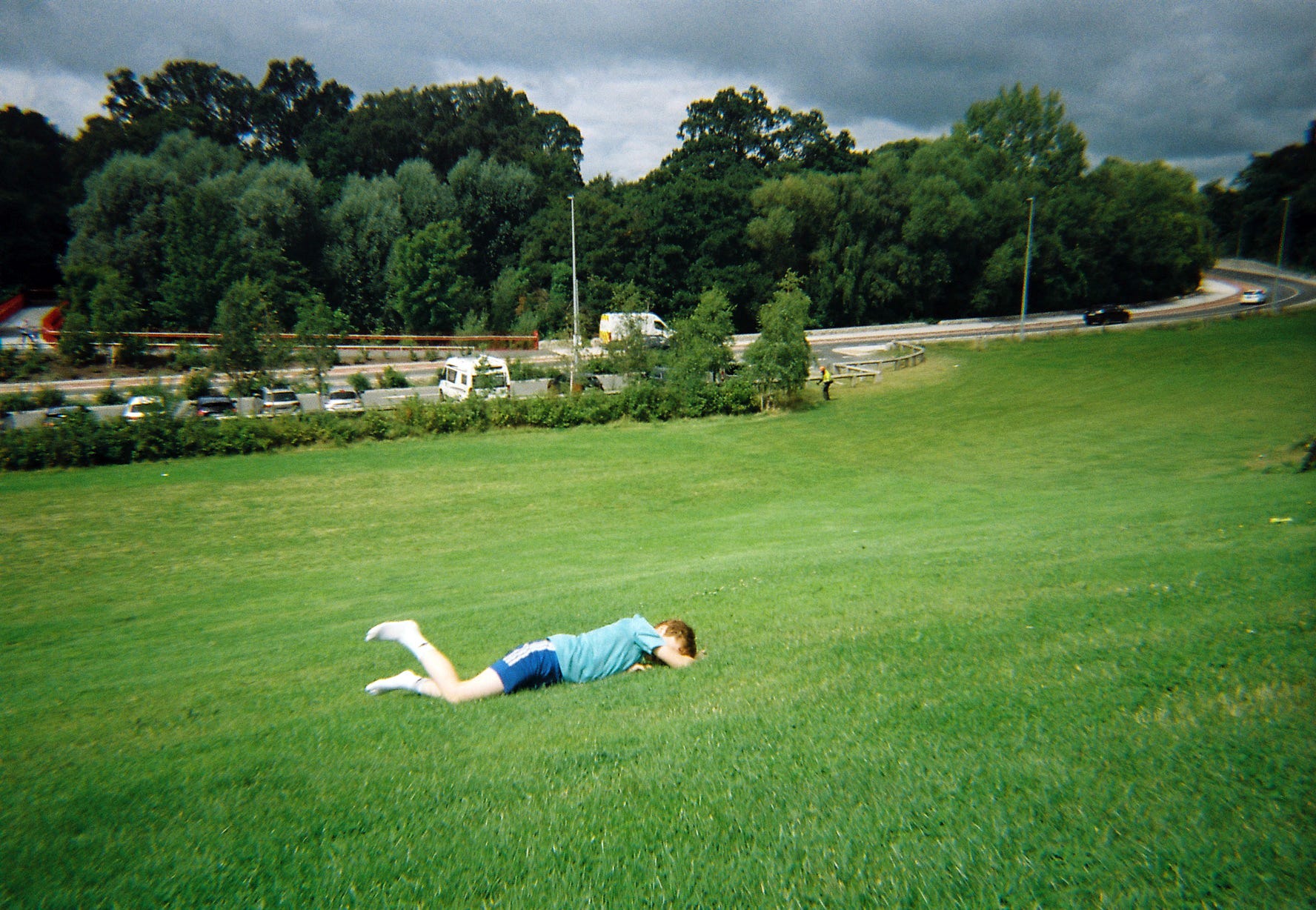
To me, the scene feels expansive yet uneasy. The green field rolls outward, while behind him a busy road cuts through the landscape, cars and vans moving steadily past. Trees line the horizon, darkened by heavy cloud, creating a sense of enclosure despite the openness of the space. The distance between my son and the road heightens a quiet tension, a reminder of how childhood exists alongside infrastructures and rhythms it doesn’t fully register.
I’m drawn to the ambiguity of his posture. It could be exhaustion after play, resistance, or simply the pleasure of feeling the ground beneath him. There is vulnerability in the way his body is exposed against the scale of the landscape, yet also a kind of certainty, a child claiming space without self-consciousness. The photograph holds that fleeting moment when emotion is physical and unspoken.
The softness and grain of the film temper the scene, altering colour and detail in a way that echoes memory. The sloping field becomes both playground and threshold, a place where freedom brushes up against containment.
My teacher is a child
With a big smile
No bitterness
(Alex G, No Bitterness)
Recently I went to a photography exhibition and I resolved to sit with each photograph as long as I would a painting. And it was interesting because I couldn’t immerse myself in the colour palette, or the brushstrokes, the different painterly choices which always lure me in. So instead I started to look at the light, the way it fell around the figures, the shape of a woman’s bare leg, her posture. And something fairly obvious struck me: beyond the stillness of this photograph, this woman will walk away and go through all the motions of her day, and there was something strangely liberating in this. Knowing that I would also leave the gallery, get the bus, pick up my kids, and enjoy these small freedoms which exist outside of the image.
“We tell ourselves stories in order to live.”
(Joan Didion, The White Album)
 NIKKI FOSTER
Leave a comment