Dear fellow artist,
I’m writing to you from 100 days of rain in Dublin, honestly, it feels biblical!
It was difficult writing this letter as I am always anxious about writing because I’m never sure if I will get my point across clearly or articulate my work properly. I’ve had this hang-up since Camberwell, where I did my degree. I left school at 16 to do a vocational Art and Design course and didn’t do A levels. When a privately educated friend caught wind of this, she kindly referred to it as a course for dummies. But I knew there was no way I was sitting more exams after my GCSEs (Junior Cert equivalent, I’m guessing), dummy or not!
So I will try to get my ideas across in my own lopsided way, and I enjoy this writing as part of the process. Over the last couple of months, I’ve continued to think about the crossover of painting and photography in my practice, questioning why I paint photographs, in particular family snapshots of mine or my mother’s. What is the fascination? I read an interesting article with Andrew Cranston recently (I’ll copy the link below) where he mentions the stuff of the everyday being more interesting to him than grand narratives, and the ‘punctum’ of particular images. Recently I’ve been overlapping photographs of past and present, or two photographs which I’ve taken on my M35 Kodak camera. It gives the same effect as a past photograph, as the plastic lens flattens everything and mutes the colours.
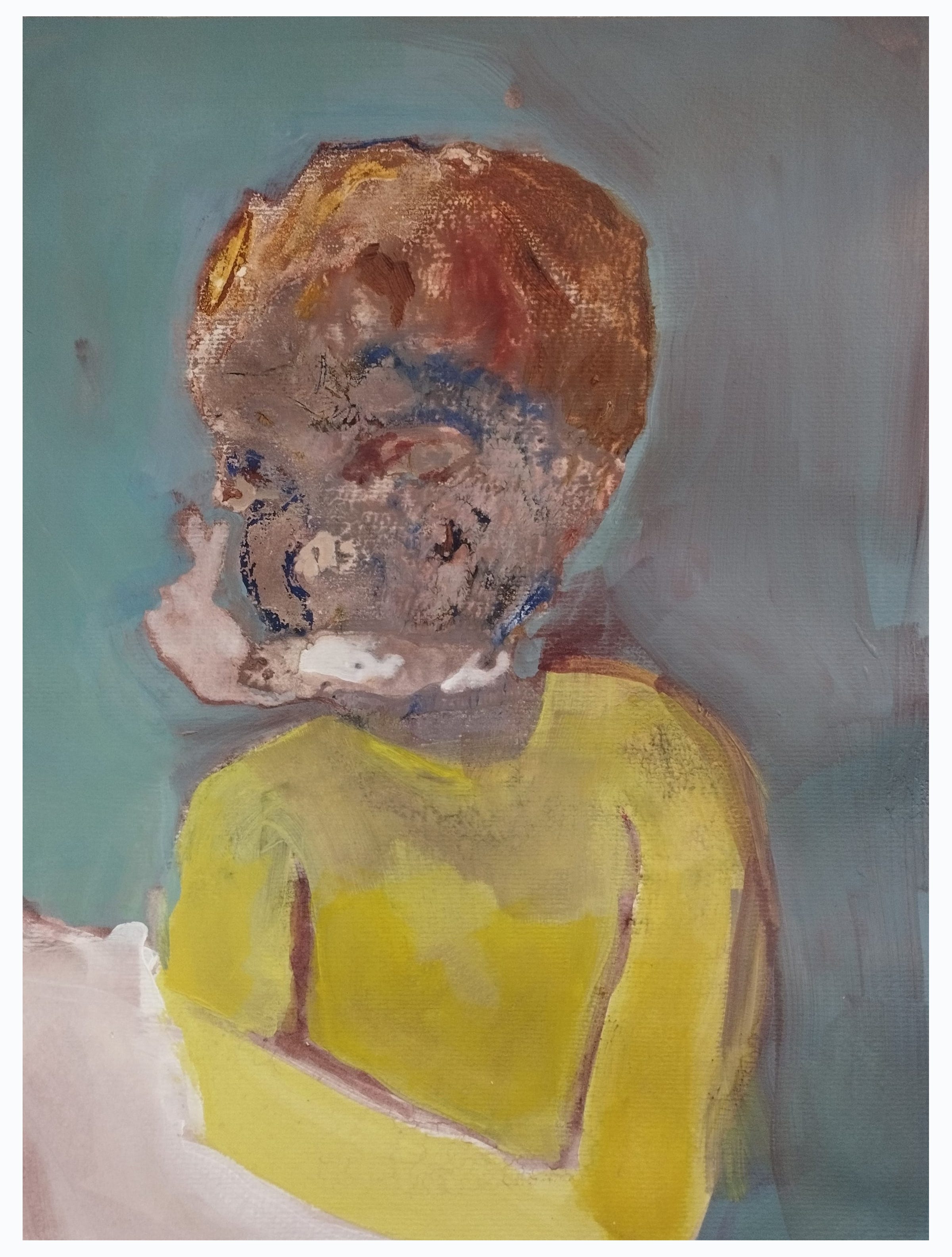
For Dream Boy (30 x 40 cm, acrylic and gesso on paper), I worked initially on a plastic plate from a photograph of my son. In the photograph he is playing with a hose in the garden, but I started thinking about his weekly swimming lessons: his teacher tries to convince him every week to put his face under water and he seems terrified (he’s five). Sometimes it’s difficult just to sit at the side and watch. The painting became a kind of daydream of Eden’s face under water, a strange journey away from the photograph to something altogether different, but still related. The transfer of the matted paint from the plastic onto the wet paper gave an interesting, claggy effect, which I tried to replicate with a different image, but it didn’t work out.
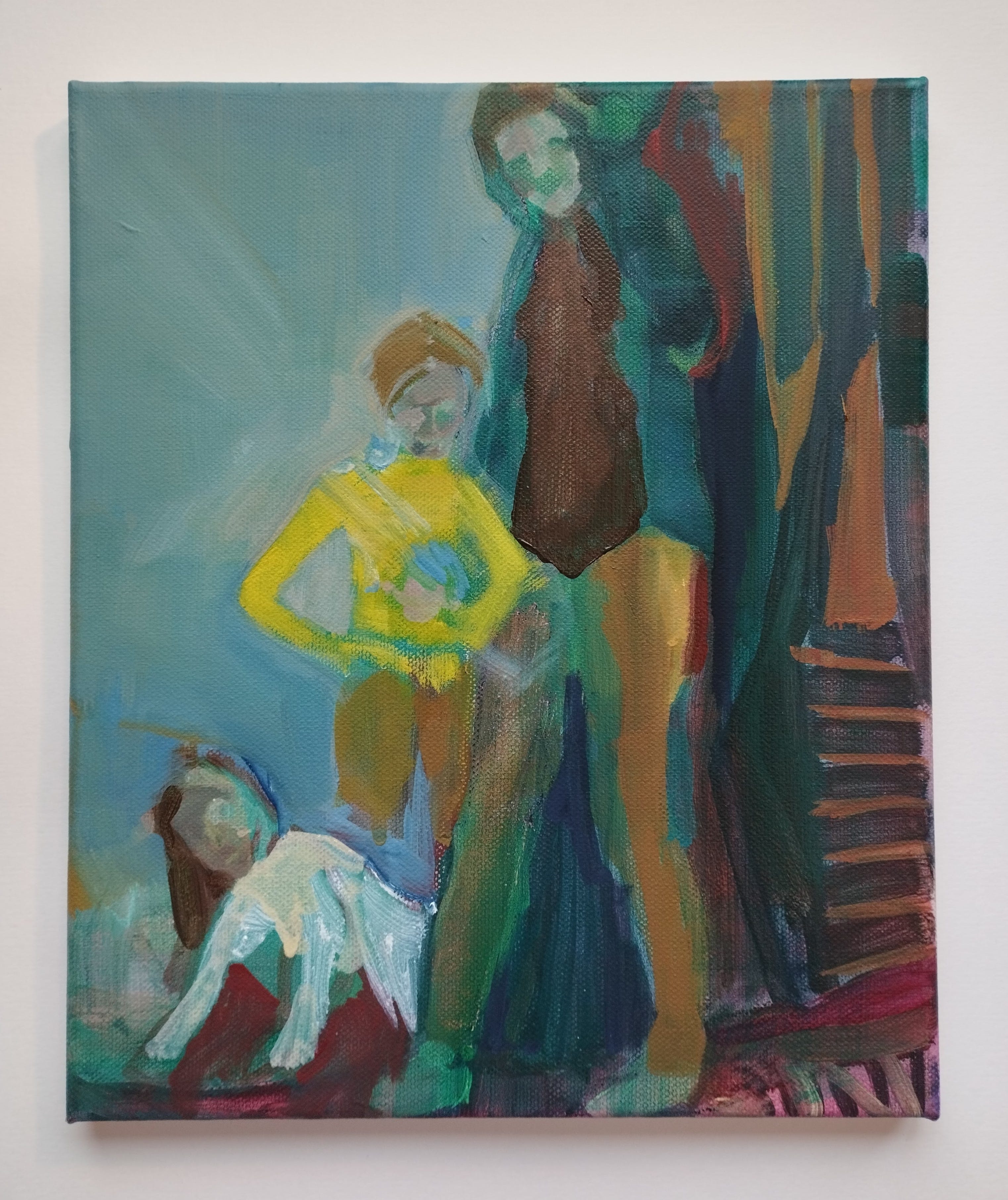
With Crawling (25 x 30 cm, oil and acrylic on canvas), I’ve tried to stay with a similar colour palette and worked from the same photograph of Eden with the hose, alongside one of him walking across a rope bridge on a wooden climbing frame, and one of myself as a child climbing a chain net in a playground. The figures took on a staggered appearance in size as I began to imagine what my son will look like when he’s a grown man, of my age. I haven’t painted myself as a child in the painting, the depiction of the child is straddled in the middle of the two adults. Again, I’m interested in the leap from the original photographs to what the painting translates. Compositionally, I want to introduce more negative space, as seen in the top left-hand corner. I know this means an intense cluster of marks in some parts of the painting and emptiness in others: I’m trying to find the right balance.
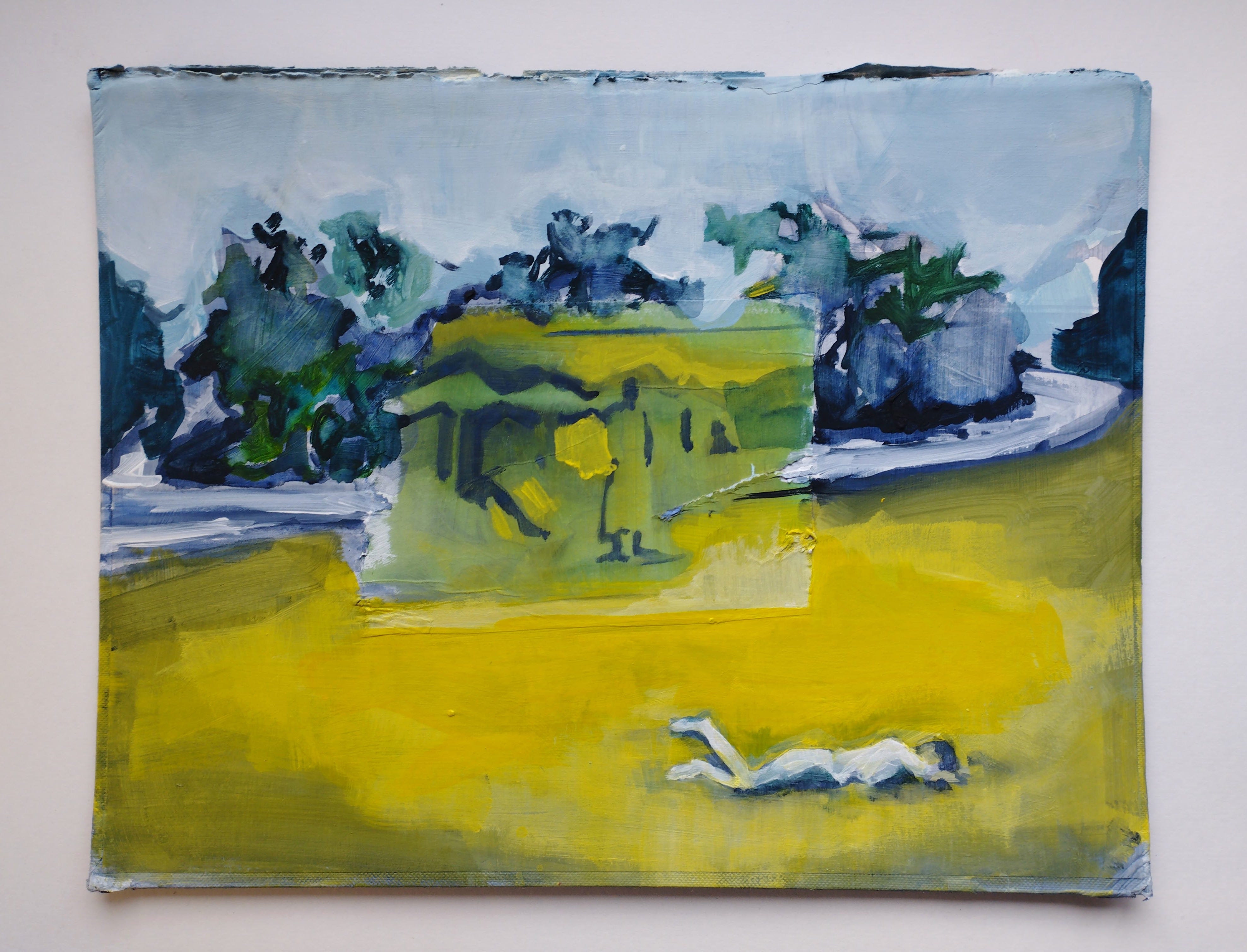
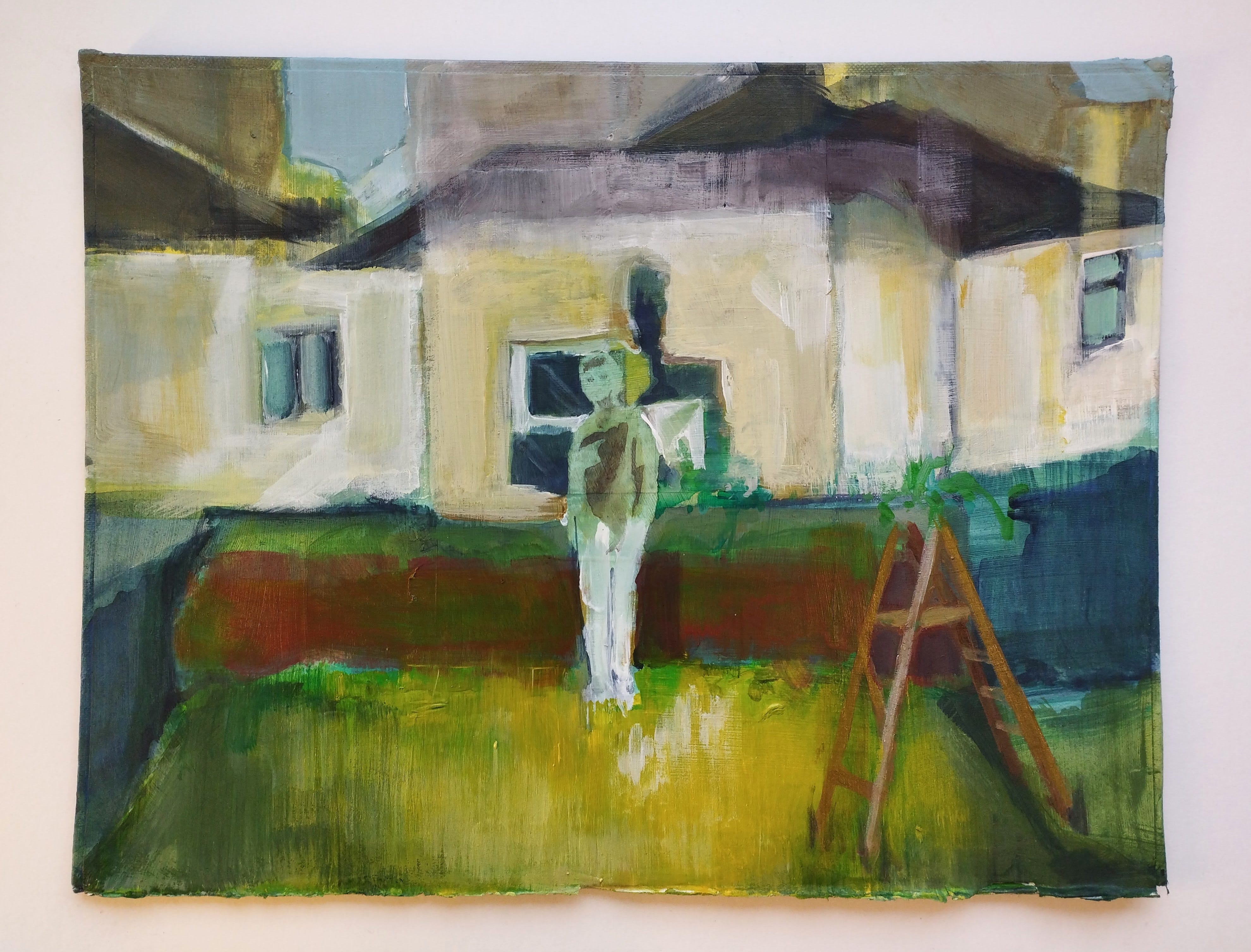
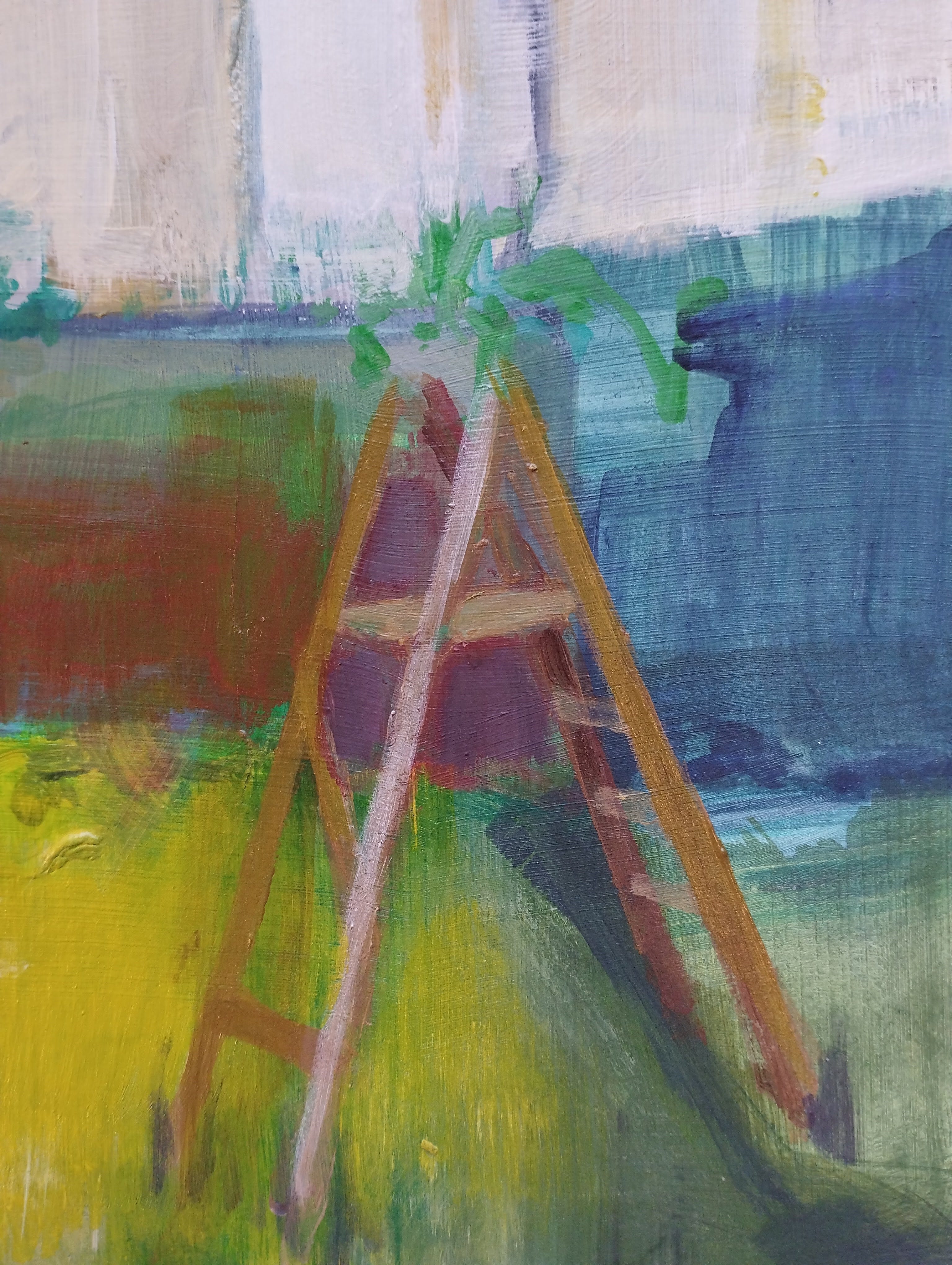
I would like to avoid the paintings becoming too fantastical, if that’s the right word, or surreal perhaps. What I’m drawn to in the photographs is their ordinariness, and I’d like this casual quality to stay with the paintings. However, I still want there to be an element of ‘something else’, because I think that’s what paint does in relation to photographs. Bypass and Suburban Garden (both 28.5 x 36 cm, oil and acrylic on hardback book covers) are attempts to make quite ordinary scenes while introducing a strangeness through the colour palette and glitches in the composition. Honestly, the yellows and greens make me think of bile, but I’m trying to stay with it because it makes me uncomfortable, and maybe there’s something in that to experiment with. Again, they’re painted from different photographs, past and present, montaged together. The ladder in Suburban Garden features in a painting I made a year or so ago, I’ve started to think of it as a time-travelling ladder, in homage to Quantum Leap, one of my favourite TV shows as a kid.
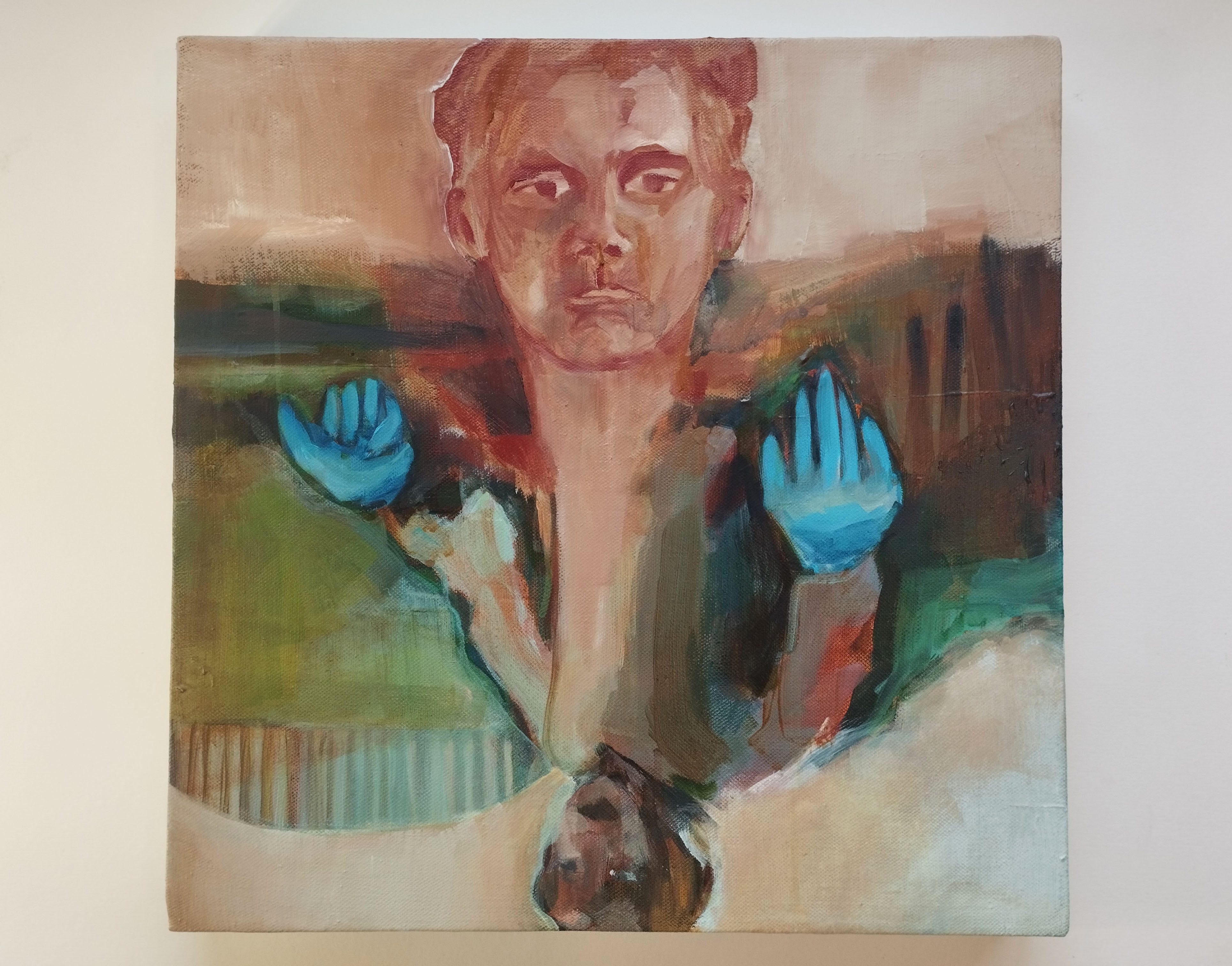
Finally, I’ll mention Hand in Blue (40 x 40 cm, oil and acrylic on canvas), which, despite my conviction above, does look very surreal. Again, it was developed from photographs: one of my youngest wearing a big, blue, shiny garden glove. The painting wasn’t working for weeks, so I decided to turn it over, a practice encouraged at Camberwell, so it became less about the representational form and more about seeing the composition differently and trying to create balance. I mentioned Georg Baselitz recently in a crit, and it didn’t go down well, but controversy aside, I’m interested in the displacement that takes place by turning an image on its head. To me it’s so simple, but so effective. In my frustration I tried it here, and for the upturned end my older son sat for me. I used Indian Red, Raw Sienna and White to paint an impression of him, and somehow the painting became about him: his moods, how he’s claiming space and growing out of his child’s body. Eventually, almost by accident or sheer will, I think it worked.
Artist-wise, I’ve recently been looking at Wilhelm Sasnal and Graham Crowley, as well as Wolfgang Tillmans. I listened to a great talk by Moyra Davey on Louise Bourgeois, and one thing that stayed with me was that Bourgeois was reputed never to be grateful, she didn’t believe in it. I found this hilarious and actually quite brilliant, because as artists we’re often in the habit of being grateful for support and patronage, when in fact it’s almost always earned three-fold. Theoretically, I’ve been engaging with Gerhard Richter, Luc Tuymans and Liu Xiaodong for their visual and conceptual use of photographic source material. I’ll paraphrase a lovely line on Tuymans’ work: ‘the painting as a beautiful cover story for the secrets of a photograph,’ and on Xiaodong, ‘for him what painting loses in terms of details of the objective world it makes up for in psychological observation.’ I’ve only discovered the latter’s work recently, but I’ve really enjoyed studying his diptychs from 2016–2017, where one half is figurative and the other abstract. It’s interesting to me how the mind tries to create a relationship between the two when they’re placed side by side.
I’m really looking forward to hearing about your work in turn, and how things are taking shape.
In paint, photographs, and the in-between,
Nikki
Footnote: the above is a draft of a letter I will shortly exchange with another artist based in Ireland
 NIKKI FOSTER
Leave a comment