
Can we play a game? My son asks as he takes a sip from a bottle of water. I pause to take a photograph, framing him from low down to catch the rim of light on his hands and face. When you take a photograph, you step outside of the moment. Out of time, the moment in motion becomes a frozen image. It’s harder if you want the subject to be oblivious to the camera. You have to be discreet and attempt to become invisible. You learn this skill, becoming invisible, as a child.
Will you play a game with me? My son repeats. ‘Yes…list all the words you can think of starting with the letter G.’ He pauses, then says, ‘grey sky, grey road, grey car, grey building.’ I laugh, ‘You can’t just keep saying grey!’ My older son turns around, ‘guillotine,’ he says impassively.
Let Me Tell You What I Mean. I hold the Joan Didion text in my hand. There she is on the cover, achingly cool. There is another woman who comes to mind, the head of my painting course at Camberwell College of Arts in 2003. A quietly intense woman, reminiscent of Didion. I think we had maybe three conversations at most during the degree course. Perhaps I am a few years shy of the age she was then.
The first exchange was in my interview, when I was painting found imagery from newspapers. “Do you think this image is more effective as a photograph or a painting?” The gauntlet was thrown down. Let the questioning begin.
The second was when she paused to look at my work hung in the corridor. We talked briefly and she said, “You should read Heidegger’s Being and Time.”
The third, a brief leaning in the door of her office, a thank you and a goodbye.
After the second encounter, I walked over to the college library. I searched the index and found it: Being and Time, a weighty volume.
At the time I ignored the recommendation. Twenty years later, I find myself probing the questions Heidegger asks about time, attention and being in the world. I am not an academic, nor do I find reading these texts easy, but since the birth of my first son 11 years ago, I have engaged with philosophy more than ever before, particularly existentialism. And now I want to know what my former lecturer got from this text.
Let me tell you what I mean.
In linking different texts to my work, their various forms, I have chosen to stay with the habits laid down at Camberwell 20 years ago. Reasoning and stating my case. Recently, I wanted to pare things back, to think of the parallels, perception and the everydayness that Heidegger delves into in Being and Time (1927).
Red, green and blue are visually linked to the digital interconnectedness of screens, the devices we are so drawn to, and the images we post and share. When my head lecturer challenged me on painting from photographs in 2003, could she have predicted the strange love triangle I find myself in now, taking a photograph, painting from the photograph, photographing the painting on my phone?
How to break the cycle, to resist the relentless scrutiny of images on devices: if I change the formula to red, blue and grey, how will it change the perception of an image or piece of work? As I write this my son’s Spider-Man stares back at me in his suit of red and blue. Nostalgically I remember we had a black and white TV in our house when I was a child, with a metal clothes hanger as a makeshift antenna. What if we just shared images of artworks in black and white? Maybe by taking something away we could give something back: imagination and wonder.
Was my former lecturer a mother? I don’t know, and it seems irrelevant. Its relevance to my own work at the moment is central. This is the space I am in, fragmented, distracted, limited, a constant push and pull, learning, adapting, and the need for patience. My time is broken down, and I piece it together again. There is also a reconciliation to be made with how you have been parented and how you want to parent. I have found this to be an uncanny aspect of motherhood. In Ghosts of My Life, Mark Fisher describes the family as a hauntological structure, shaped not only by the past we inherit but also by the futures we imagine.
I made a zine after my daughter was born thirteen years ago. Two boys followed. After my second child I had to start doing the work, the mental and physical work, of remembering my-self. We moved to Dublin when my son was a newborn and my daughter was two. What theologian and philosopher Simone Weil terms ‘rootedness’ (1949), a feeling of connectedness to a community, place, tradition, history: I had lost. But can something or someone thrive within a set of limitations? In our early years in the city, I had a mental radius of where I would go. I mapped out parks and playcentres. One afternoon, we ventured somewhere new only to find the gates locked. It was a private grounds for a fee-paying secondary school. My daughter sat on the pavement and cried.
Gradually our boundaries expanded, and we ventured outwards. Now I watch my thirteen-year-old daughter with her phone in her hand, ‘ready-to-hand’ as Heidegger illustrates in Being and Time. But while he draws on the medium of the radio as creating a sense of remoteness in human experience, now we have to contend with smart phones and devices. And I want to push back, to make stuff, real stuff, which can be held, hung or thrown aside, but nevertheless can be passed from person to person in a physical sense and can create an ephemeral feeling of tactile intimacy.
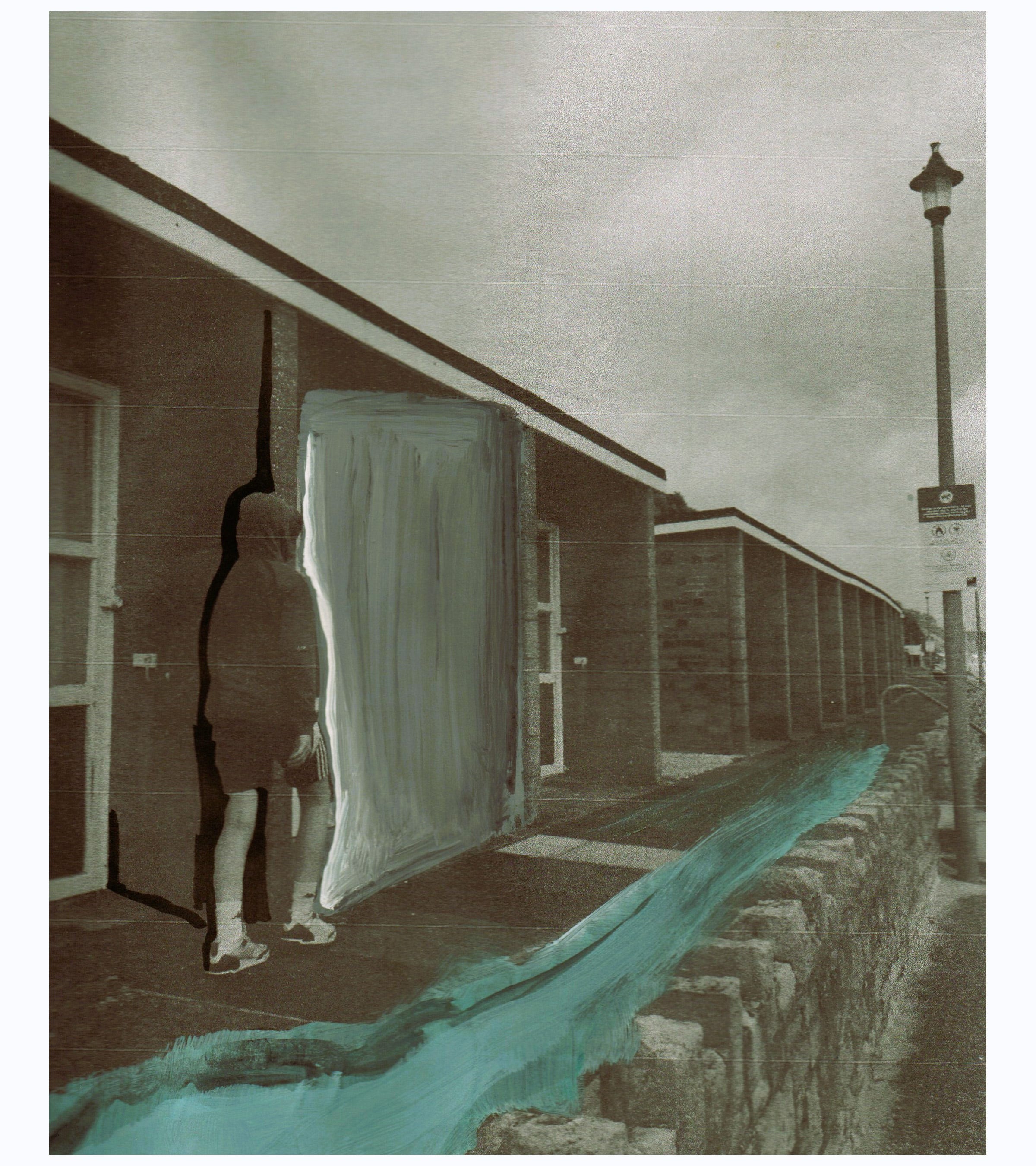
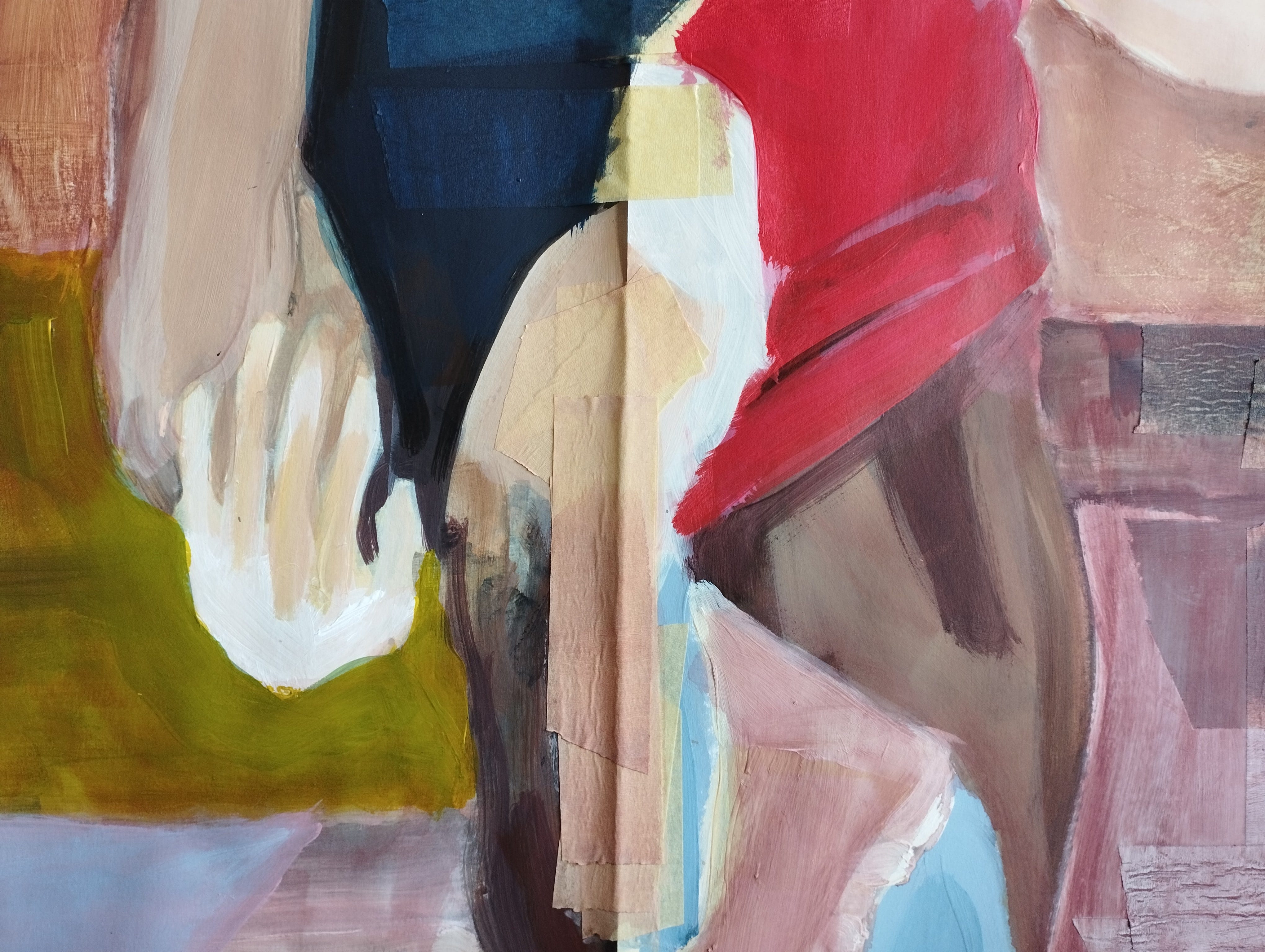
My latest project is a time, image and colour restricted zine, alongside other work, specifically paintings from photomontage: images broken down and pieced together again. Heidegger calls out forms of perception as distant. Seeing and hearing as primordial, yes, but remote. They are a part of being in the world but cannot wholly describe it. Essentially, he argues that time grounds the meaning of everything we do. We are always drawing on the past or envisioning the future as we stand in the present. My current WIP zine, titled 31–8, has fragments of colour associations written as text, centered on red, blue and grey, nodding to this sensation of being in the world while perceiving colour through time and experience, because how do we give something our full attention?
In ‘Atmospheric Attunements,’ Kathleen Stewart (2009) suggests that what Heidegger terms as ‘Worlding’ calls for a complex sensorial awareness: An intimate, compositional process of dwelling in spaces that bears, gestures, gestates, worlds…What affects us – the sentience of a situation – is also a dwelling, a worlding born from an atmospheric attunement.
Simone Weil also argues in Waiting for God (1950) that attention is the purest mode of generosity. However, what vies for our attention in any given moment? Is it a need, a desire, a memory, or an algorithm? Is it possible to transcend our time, to experience and perceive something with our full attention, to be-in the world rather than of it?
The painting, the photocopy, the zine might feel archaic, nostalgic even, but by going back maybe we interrogate how we can go forward, to stay with something, to be in our ‘alongsideness,’ and pause. A note that the late David Hockney had pinned to his studio wall read aptly: “Put down your phone and look with both eyes.”


Leave a Reply