Yesterday morning I booked a seat for a talk by Hettie Judah at Rua Red in Tallaght, Dublin: How to Enter the Art World After…
Around the same time, I read this line by writer Sara Baume in an article written for Ocula magazine: ‘I am a solitary person, generally disinclined, at this stage in my life, to attempt to establish new relationships.’
The two experiences of looking, booking, and reading seemed to fold in on each other.
My interest in Hettie Judah’s talk stems from my position as an artist who took a break from making when I was working full-time for a gallery and when we also moved from London to Dublin with small children. I say I took a break from making, but this isn’t strictly true, as I was still making artworks, but I wasn’t attempting to put them out into the world.
When I began to feel the drive to do this again, I found myself in a new city with three small children.
Sara Baume’s words hit a chord because I have heard an alternative version of this before: ‘I can’t take on any new friends at this stage. I don’t even have time for the friends I have.’ This is a difficult reality for an adult who finds themselves having to start again socially, particularly in a new place.
To be fair to Baume’s words, which I can relate to as a solitary person, she expands in the text on how she contacted Mollie Douthit, the artist she discusses in the essay, after seeing her paintings. They went on to develop a rewarding friendship. I find their experience of finding kinship through art hopeful and fortifying.
However, I would like to consider the silent privilege embedded beneath words along a similar thread: the privilege of being in a position where new friendships are optional. I often wonder how these individuals might feel if the tables were turned, and they were faced with the loneliness and isolation of moving to a new country, and the vulnerability which comes with establishing new friendships. From my personal experience, I have developed a newfound appreciation for this aspect of migration.
It is a slow thing to be let into someone’s life, and you can’t force it, nor would you want to. Building the nuanced framework of friendship can be out of your control. And as much as you might try, they won’t always flourish. You have to acquiesce. When I accepted this, things became easier and less frustrating.
I have taken art courses and made an effort with artists that seemed open, or I clicked with. With like-minded artists from these courses, we self-organised exhibitions in Ireland, the UK, and the Channel Islands.
I will be interested to see what Hettie Judah advises in her talk. Sometimes you have to accept your circumstances as they are at the time. I have three children: it is not possible for me to go on residencies at present. I did, however, when we first moved, do volunteering for my local baby and toddler group, and also for Dublin Open House weekend, in order to get to know the city’s heritage sites and meet other creatives. I was involved in exhibiting work for charities such as Sheltered, and on two occasions I hosted a stall at Dublin Comic Arts Book Festival in an attempt to get to know other zine makers.
Now I apply to open calls and attend private views when I can. This can be cliquey and awkward, but it is about showing up and taking an interest. It does take energy and enthusiasm. If your kids, jobs, or both have been sucking you dry all day, you may not have it in you.
At these events, you notice the restlessness you might inspire in some individuals: I am not going to gain anything from this conversation, so I am looking over your shoulder to see how quickly I can move on elsewhere…
The wandering eye.
Well, I have no interest in transactional friendships, so I let them go on their merry way. As I enter my 40s, I am intrigued to see what this new chapter in artist friendships and making brings.
I once responded to an Alexis Sol Grey post on Instagram, where she wrote she had decided her third child would be her career: her paintings. ‘Can your fourth child be your art career?’ I wondered aloud in the comments as a response. ‘Go for it,’ she wrote back, which is exactly the openness and enthusiasm I needed.
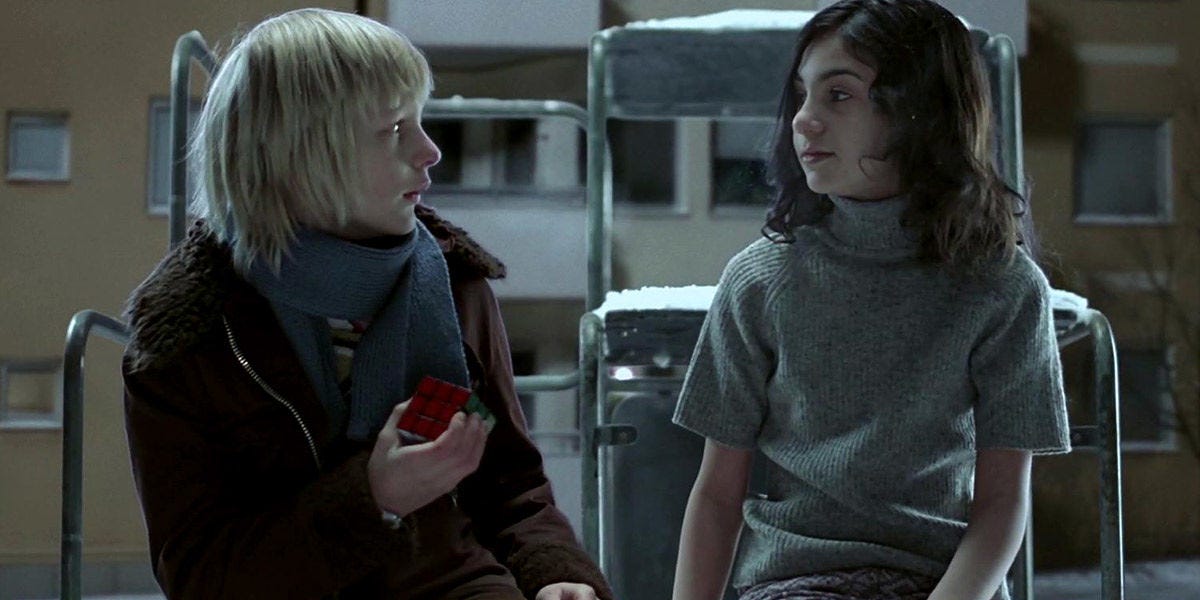
It makes me think of Let the Right One In, a brilliant Scandi movie about, in brief, when a child vampire befriends a vulnerable boy who is being bullied. It is based on the novel by John Ajvide Lindqvist. In the film, Eli, the child vampire, explains to Oskar that she cannot enter his house without being explicitly invited, a rule that causes her physical harm if violated. This moment, where Eli insists on this verbal invitation, is a critical turning point in their friendship.
Except I am not a vampire.
I am just an artist, a mother, a daughter, a teacher. And when all of these labels fall away, somebody who is left open.
And you do have to be open. Baume describes how she found herself in awe of Douthit’s ability to repeatedly re-establish herself in unfamiliar places, and I am in admiration of this too. I have found it particularly challenging with children, not only in establishing an artistic network but also in finding paid work which does not belong to the gig economy. Baume says, tellingly, that Douthit was constantly open and unguarded when asked probing questions, and I think this openness comes, in part, from a desire to connect with others. To be seen, understood: to be let in.


Leave a Reply