Note to reader: This is the draft of a letter I will shortly be sending to another painter as our first correspondence. If you are not a painter, you might find it very boring. In fact, if you are a painter, you might also find it very boring.
I am looking forward to entering into this correspondence with you. My reasons are fairly straightforward, in that I think it is quite rare to be able to get critical feedback on your work as a painter from a painter who has also probably spent a large amount of time looking at and thinking about painting.
What I like about the exchange of letters is that I will be able to sit with your insights for an indefinite period. I can highlight different areas. Words can carry such weight and authority, can’t they?
Also, as a painter with a home studio, it feels like I am inviting someone into what can be an isolating making experience. This setup works for me now, though, as I paint in windows of time around childcare and other work. I also like to work in a quiet space on my own where I can think.
Originally, I am from Bournemouth in the UK, but I am now based in Dublin. I started painting at Camberwell College of Arts when I was 19, studying there between 2003 and 2006. Prior to that, I completed a BTEC in Art and Design at 16, followed by a foundation course.
I’ve come back to painting seriously in the last few years after having my children and realising how much this was missing. A lot of my work relates to my experience of motherhood, but I don’t see it as being solely about that. It is perhaps closer to a voyeuristic look at childhood and a chewing over of experiences, past and present.
I am interested in ideas around hauntology, particularly when it comes to familial structures. Often my day-to-day experiences filter into the work and manifest as something different.
For example, recently my son, who is six, and I were having a tickle fight. Suddenly he burst into tears. He said, “I don’t want you to die.” He was crying so much, the tears were dripping down his face onto my arm. “What if I can’t find you in heaven?” he said. “What if I can’t find you where you spawn?” To comfort him I told him I’d wait for him and I’d find him. I’d get a place ready for him with all his favourite things. Despite him settling down, I felt disturbed by the exchange, all the talk of death. The painting Creeper is partially derived from this experience.
I have always been interested in how we can occupy alternative realities, whether in our imagination or in dreams. Religion and spirituality, I’m sure, allow this for the faithful. The drawing House Flood is loosely based on a vivid dream where I came down the stairs to find our home flooded and resembling a lake. I needed to get the kids ready for school, so I swam to different islands to retrieve things: uniforms, bags, shoes.
I often wonder if painting is a way of occupying these alternative realities, expelling them, or both.
I have been studying images of Sienese paintings. I am drawn to pre- and early Renaissance painting, particularly in the strange spatial arrangements and the more intuitive perspectives. In my catalogue by Timothy Hyman, 2003, it is Sassetta I turn to again and again in terms of his otherworldliness, which is sometimes sinister, such as Saint Anthony Beaten by Demons from 1425. The way he divides up space with colour and light, see Saint Francis Gives His Cloak to a Poor Knight and Dreams of a Celestial Place. I find the subtlety of colour combinations in these paintings so intriguing.
The former painting, it is said, probably has the first naturalistic cloud-streaked sky in Italian painting. These studies have encouraged me to introduce more ultramarine blue, ochre, and also lemon yellow mixed with titanium white.
For Creeper, I also looked at Sorolla. When I went to an exhibition of his work at the National Gallery of Ireland, it blew me away. The light, the colour, the feeling of life. I found it so transportative. The colour palette is also something I’ve tried to emulate with the blues, ochres, and whites.
Another artist I’ll mention is Henry Darger. Despite his work being disturbing and difficult to look at at times, I find it compelling in that you are able to enter his world that he constructed, one populated by young girls often suffering in strange landscapes. I recently read his chapter in Olivia Laing’s The Lonely City, where Laing conducts thorough research into his life and work.
What I found interesting in terms of my own practice was how he collected found imagery, traced and collaged it compulsively until he began working on a painting. I myself use photography as a current in my practice, which can also translate into paintings. I often create a photo montage and work from this to prompt a piece. Occasionally I will flip a photograph back on itself to create a mirror image, and then I will use both photographs merged together. For example, Creeper, Yellow Submarine, and Bather were all done using this technique.
The photographs are of my day-to-day surroundings, at home and in local parks mostly, minding my children. Recently they feature my sons, but occasionally my daughter, who is the eldest at 13.
More contemporary painters I will mention are Michaël Borremans, Jonathan Waterridge, Noah Davis, Luke Timmons, and most recently Amelie von Wulffen. Photographers I admire include Moira Davey, Vivian Maier, and Wolfgang Tillmans. I’m sure there are many others I have missed. Maybe these choices suggest a certain sensibility. I tend to veer towards things that are diaristic, melancholic or strange.
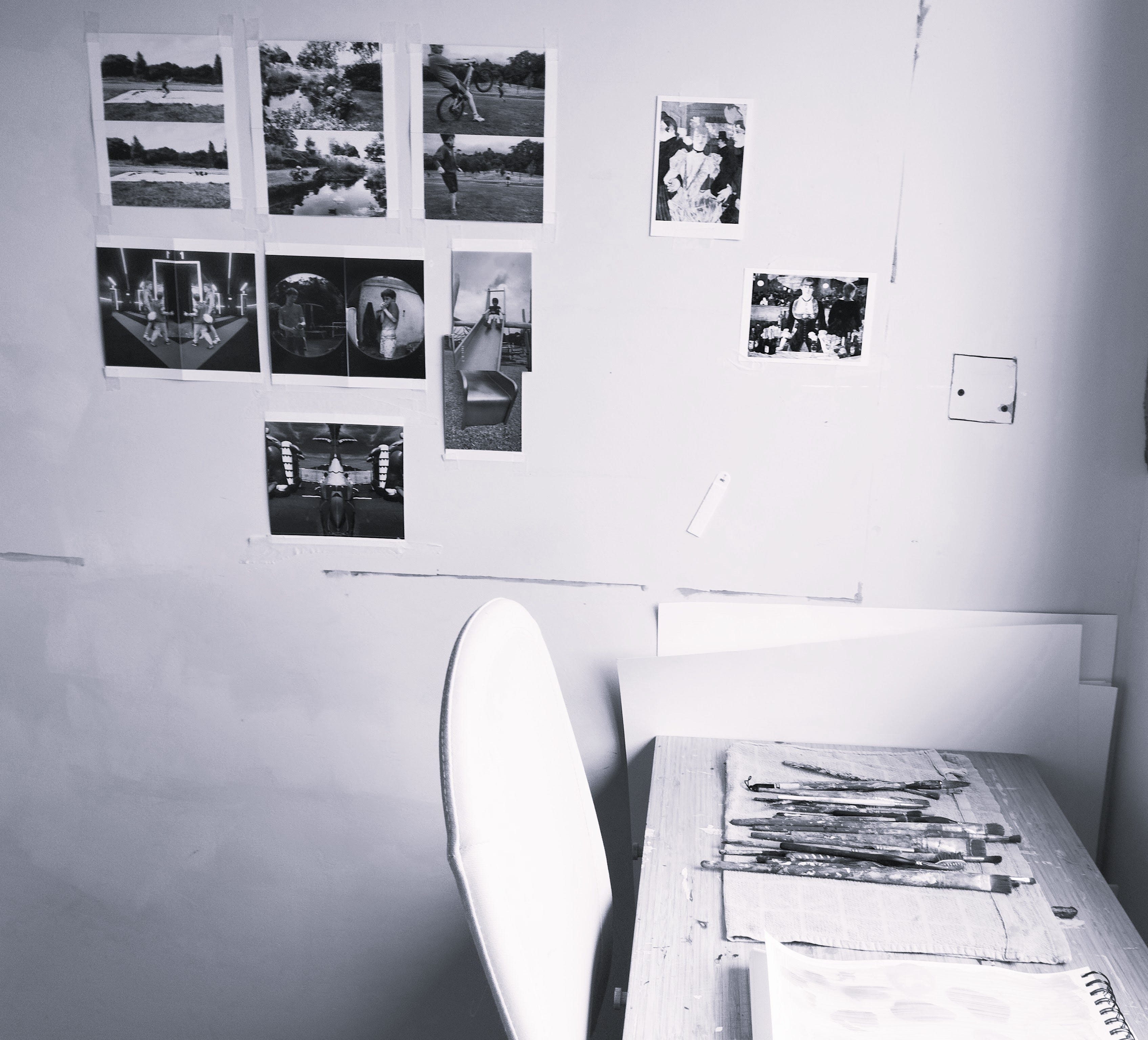
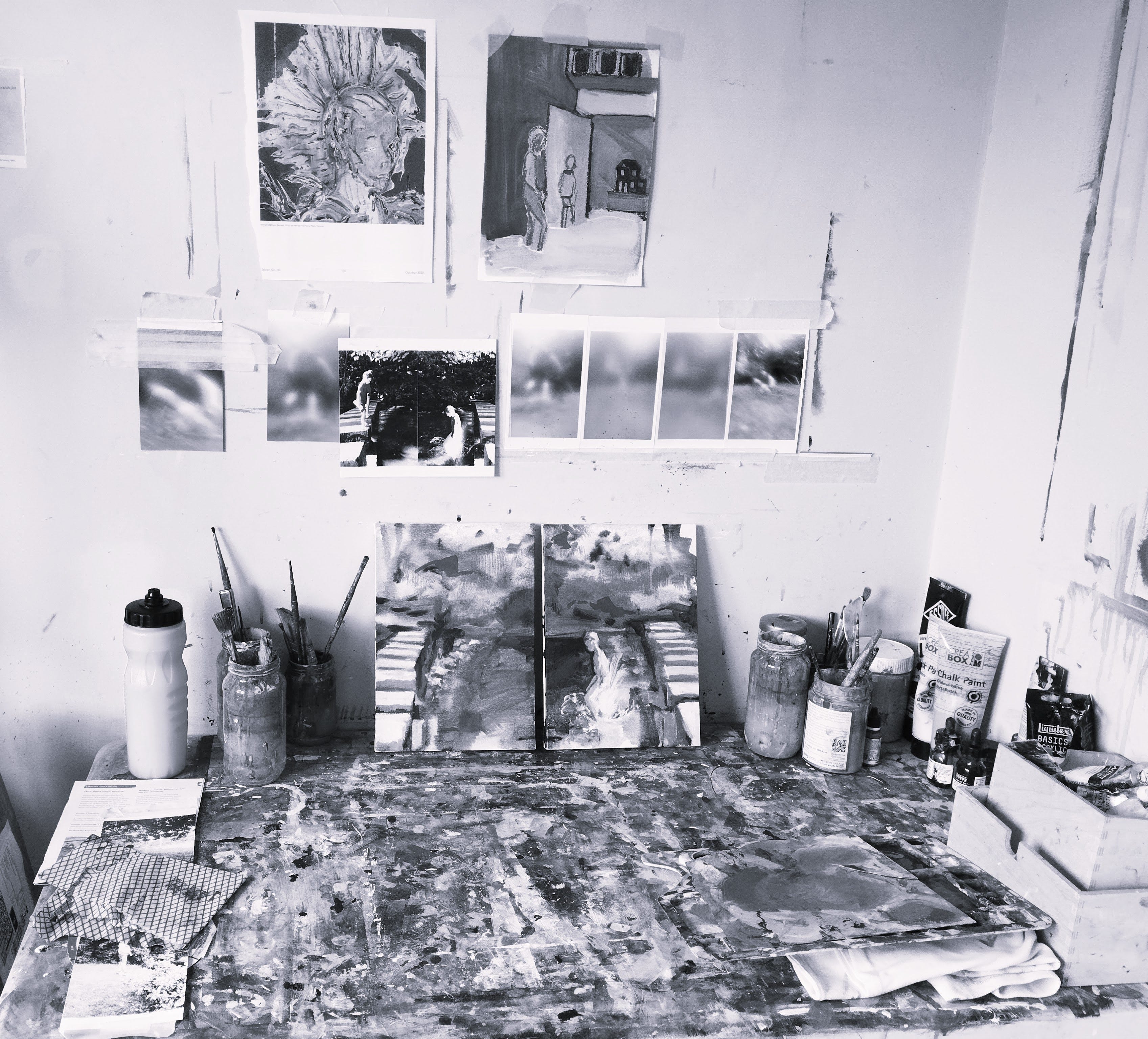
In terms of materials, I have included a couple of pictures of my space in case this might be of interest to you. I work in the box room of our suburban home in Dublin. The room measures approximately two by two and a half metres.
In terms of paint mediums, I will generally work with acrylic first for the blocking in and water-based oil paints for later. I started using water-based oil paints to keep the toxicity of turps away. My son has asthma and finds even oil paint diluted with linseed oil triggers him. I actually like the adaptability of the water-based oils, and the colour range is decent, although I tend to use the same colours: Prussian Blue, Ultramarine, Indian Red, Crimson, Yellow Ochre, Lemon Yellow, and Titanium White, sometimes Phthalo Blue and Burnt Umber.
My favourite brushes are flat-edged, but I have introduced more rounded brushes recently. I generally don’t use mediums or varnishes, just water for mixing.
The room has three work areas: a painting table for when I want to work wet-on-wet and need the canvas to be flat; a painting wall where I will stretch paper or hang small canvases that I’m working on. Often this can be three or four at a time. I try to save the dry desk for any photomontage or drawing, or just thinking.
I generally work, if I can, for an hour or so in the morning and again in the evening. Mostly the canvases and drawings are small, A3-sized and up to A2 at a push. Over the summer, I worked on two large paintings on paper for an exhibition, where we were encouraged to move outside of our comfort zone. But honestly, I felt lost in the larger size and prefer working on small, easily mobile canvases.
I tend to choose stretched canvas as I like the tautness under the brush, and when primed can predict the absorbency. Occasionally, however, for paintings like Bather II, I experiment with a different technique. This painting and others I have made previously I would classify as a sort of monotype. I will paint onto an A2 plastic clear plate and then wet the fabric slightly before pressing it onto the plate. The water-based oils work well for this as they stay wet.
Once the fabric is dry, I will then stretch it over a frame. I have found my sons’ white school cotton shirts work well, so when they have grown out of them or they are too worn for wear, I save them and use them for this. Once the monotype is stretched, I often work into it in places, accentuating some areas.
It is hard to specify why I choose the prompts to work from that I do. Usually the images trigger a feeling, or there might be an uncanny quality to them I want to play with. Often, I sit with the photographs I take and narrow it down because I take a lot of photographs, both digital and 35mm film. Then I start sketching with the paint straight onto the canvas, trying to tease something out.
I am not that confident about my drawing skills. I’ve never been able to grasp perspective. I could try harder, but it doesn’t really interest me as much as painting. I’d rather focus on trying to move through the photograph and create a mood or atmosphere.
What does a painting do? What do you think? Maybe I’m asking the wrong question, and we shouldn’t have any expectations of a painting and what it can do for us or what we can get from it. Perhaps, once complete, it’s an autonomous thing. That said, I read an article with Marcus Harvey a couple of years ago where he said painting should fuck with your day, and I really liked that. But I edge towards this idea in my own quiet way.
Sometimes I work on a small painting for ages, much longer than I want to, but I’m quite loyal or persistent. I try not to give up on something even if it is not working.
Despite my love of photography, I find I can sit with some paintings longer than anything else. I want to pull apart how it was made and why it was made.
Recently I kept coming back in my head to a strange painting I saw in the Stedelijk Museum in Amsterdam by Marc Chagall called The Pregnant Woman. It is quite ugly: the woman’s sick, green, anxious face, her finger pointing to the unborn baby in her womb like a cross-section. A contented man’s face looms above a house to the side.
I sat with the painting for a long time, a man painting a picture of pregnancy, and in my eyes at least, getting it right. I think I left feeling a bit angry or unsettled in some way. You could say the painting fucked with my day.
What do you think my paintings are doing? Other than taking up small windows of space. I would like to push them further, maybe take more risks. Don’t hold back. Be as critical as you like. That is why I am here after all.


Leave a Reply